
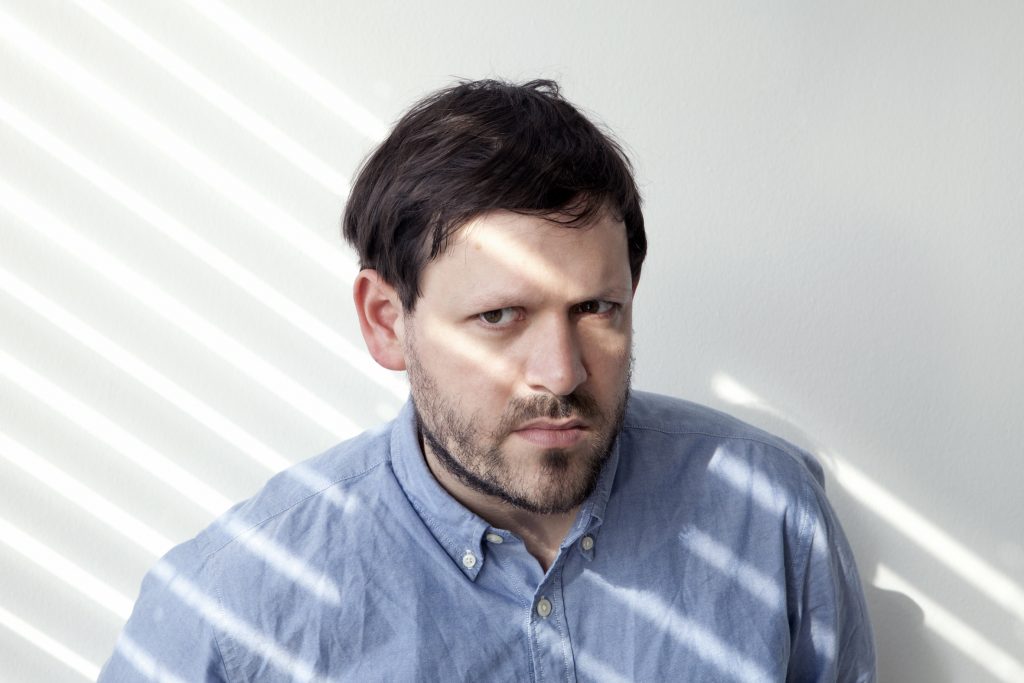
March 2014 sees the album “Decay” released by Berlin-based DJ/producer Efdemin (Real Name Phillip Sollmann) on German label Dial Records. It is the third LP to be released by Sollmann on Dial, with whom he has a close association, having put out both the self-titled ‘Efdemin’ in 2007 and his second release ‘Chicago’ in 2010. Formed in Frankfurt in early 2000, Dial Recordings has an interesting and varied back catalogue; their releases cover a myriad of intricate techno courtesy of artists such as Pantha Du Prince, Roman Flugel and John Roberts.
Decay is a purely minimal record. It sees the artist explore a deep and organic post-techno sound and in the words of Sollmann himself, a “more coherent” LP than his earlier releases. For a majority of the recording process, Sollmann and his partner relocated from his native Germany to the Japanese megalopolis of Kyoto, becoming fully immersed in the local culture. They stayed in a studio apartment by the river as a part of a three month artist residency, becoming deeply absorbed in the Japanese lifestyle. They lived amongst the beautiful and peaceful Blue Mountains.
The couple visited temples and shrines, and along with his partner (a visual artist) took walks as she filmed images for a project, spending from September to December in the city. The calm autumn surrounds and atmosphere were huge influences on the sound and feel of Decay; a photograph taken by Sollmann is the album cover art for a record very much borne out of unfamiliar but revered environment. Sollmann researched Japanese instruments and visited flute makers and bell collectors on their pilgrimage.
For Decay, Sollmann explores the beauty in decomposing organic beings, with this luscious and captivating post-techno album. He captures a sense of the rolling-yet-calm pace of life that he found in Kyoto. It is deep and laden with drones and murky noises. Sollmann captured and deployed the sounds he heard, the album’s sounds are organic and carefully nurtured, and they explore natural forms and the mortal nature of life.
This release adopts noticeably deeper techno sound when compared to his previous LPs. Sollmann has captured sounds which could only have been recorded in those uniquely green and fertile pastures that Japan provided. Sollmann typically would use his cherished Berlin studio, ‘the Meadow’, but he adapted to recording using headphones for this record whilst away from home; an approach he had neglected for many years.
The record begins with a recurring bleep and a deep heartbeat of a bass line on the opening track ‘Some Kind of Up and Down Yes’. After its brief intro, we hear a voice asking the question: “When you appear before audiences, do you ever wear less than you are wearing now?” – possibly a stab at those popular music figures who feel the need to flaunt too much skin. It is only Sollmann‘s music that is stripped down and raw.
In ‘Drop Frame’ we are treated to some wood-chime techno and static sounds which are composed to accompany the rattling bass. ‘Transducer’ is a more formulaic and haunting six minutes. A harrowing voice repeats the track name over a ticking which echoes and builds the track’s momentum.
‘Solaris’ takes us on a voyage. It swirls with a mesmeric ring but remains true to the album with its mucky and driving bassline. At 8 minutes, title track ‘Decay’ is the heartbeat of the record and builds us up for the subsequent abrasive techno tracks which follow.
After an engrossing start, the middle third is distinctly heavier, with ‘Subatomic’ and its many layers of distortion, to ‘Track 93’ with its vocal sample, “I got a lot of love, around here.” It’s twisted and distorted and the vocals play above a series of claps and obscure sounds.
‘The Meadow’ is perhaps the grooviest track on the album; its brooding piano chords could be homage to Sollmann’s studio in Berlin as parts of Decay were recorded there as well as in Japan. It has a reminiscent feel about it and an inherent sadness which again is prevalent in ‘Parallaxis’ which follows. Both tracks are minimal in their composition and draw the album to a bright and tranquil conclusion.
The album is bookended with two vocal samples, on the final track, ‘Ohara’, Sollmann leaves us with a short passage about being able to physically touch music, and it is and fitting end to the record. The vocal snippets back up the murky beating textures that shroud us throughout the album, as the artist explores the paradoxical beauty between beauty and decay.
Sollmann is now preparing a Decay remix album along with a couple of other Efdemin releases on different labels. He’s also planning a return to Japan with his partner to continue working on their respective arts as well as filling up is calendar with a number of live gigs, currently including a date at Berghain / Panorama Bar in Berlin alongside Marcel Dettmann, Delano Smith and Ryan Elliot.
Decay is released on March 31st 2014 on Dial Recordings.


![Linnea Dale & Of Norway – High Hopes (Of Norway Versions) [Beatservice Records]](https://thenoisegate.com/app/uploads/2018/05/1621821_760238663994164_592289460_n-500x316.jpg)
![Schmeichel – Alteration EP [Defrostatica Records]](https://thenoisegate.com/app/uploads/2018/05/0013083927_10-500x313.jpg)